
Why top custom home builders are using car-manufacturing precision methods like BIM modeling, factory-built components, and sustainable materials for true luxury craftsmanship.
Walk onto the floor of a Porsche or Rolls-Royce plant, and you won’t find chaos. You’ll find choreography. Every panel gap is measured in fractions of a millimeter. Every component is engineered digitally long before it’s cut, welded, or stitched. And yet the car that rolls off the line is still unmistakably yours: your color, your interior, your options.
That same logic sits at the center of how we approach custom home construction at BuildLabs. Traditional custom construction has a reputation for a stack of blueprints, a contractor working off instinct and crossed fingers. We don’t build that way. We never did. For more than a decade, our approach has looked closer to automotive manufacturing than to a traditional job site: model the home digitally first, build the critical systems in a controlled environment, and put skilled hands to work on the details a homeowner lives with every day.
Car companies stopped shaping metal by trial and error decades ago. Everything gets modeled and tested in software long before a physical part exists. We build every home the same way, using Building Information Modeling (BIM) to create a digital version of the house that includes structural, mechanical, and energy data alongside the elevations and floorplans. A duct that won't clear a bean gets caught onscreen during design — not discovered halfway through framing when corrections are costly. Borrowing from proven techniques and systems throughout Europe and Australia, we ran projects this way years before it became a buzzy talking point in “new” residential construction. It’s why our builds hold tighter tolerances from groundbreaking to final walkthrough.
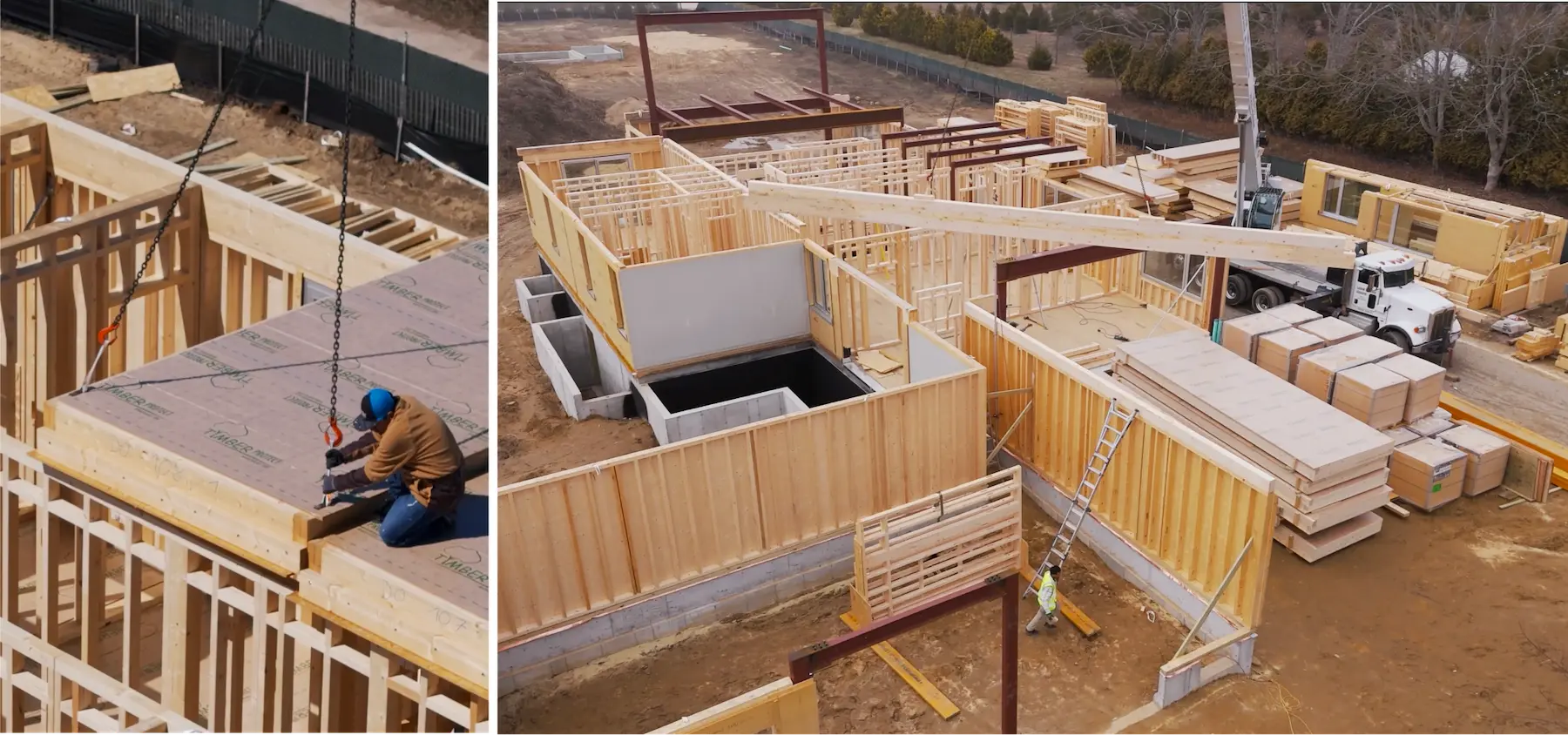
Automotive plants stay climate-controlled because consistency requires cutting out variables. We built our own capabilities around the same principle: produce key components like cabinetry, trusses, and wall panels in controlled environments where they aren’t exposed to the weather and schedule pressures they’d face on an open lot. Components built this way arrive with tighter tolerances, better insulation, better air sealing, and none of the material damage that comes from sitting exposed on a job site for weeks. Our timelines run faster than fully site-built construction as a direct result — 30 to 50 percent faster in most cases, since factory work doesn't stop for rain and doesn't wait on a trade schedule.
The wider market is only now catching up. A January 2026 report from CustomRock valued the global factory-based construction market at $111 to $173 billion in 2025, projected to reach $119 to $183 billion by the end of 2026. It named digital modeling, AI-assisted design, and robotics as the drivers behind that growth. We operated on these principles long before the shift showed up in the numbers. We call it Building Beyond. It’s not a trend we adopted, but an approach we’ve spent over a decade perfecting.
A Bentley buyer doesn't give up a bespoke interior to get sound engineering underneath. The platform takes variation without breaking, and that's exactly how we think about high-end residential construction. Precision manufacturing doesn't limit what a homeowner can ask for. It's what makes real customization possible at scale. Our teams design additions that integrate seamlessly with existing structures, build to the specific demands of a property, and tailor every system to a client's actual lifestyle instead of a standard template. The result is a home that's fully personal, built on infrastructure that's engineered and proven, not improvised.
Modern luxury vehicles treat fuel and energy efficiency as core engineering, not a marketing line item. We hold every build to the same standard. Carbon-neutral materials like mass timber, recycled composites, and low-impact concrete alternatives go into our material selection process from day one, and they shape long-term maintenance planning for every home we deliver. For our clients, sustainability isn't a checkbox added late. It's a baseline we design around from the first model.
We don't reach for a car manufacturing comparison because it sounds good in a pitch deck. It describes how we build homes: model it before you build it, manufacture the critical systems with precision, and let skilled hands finish what a homeowner will actually touch. The result is still one of a kind. It's engineered that way, not hoped into existence.
At BuildLabs, that's the bar every project meets, and it's the same bar we set for ourselves long before the rest of the industry started building this way.
.png)